
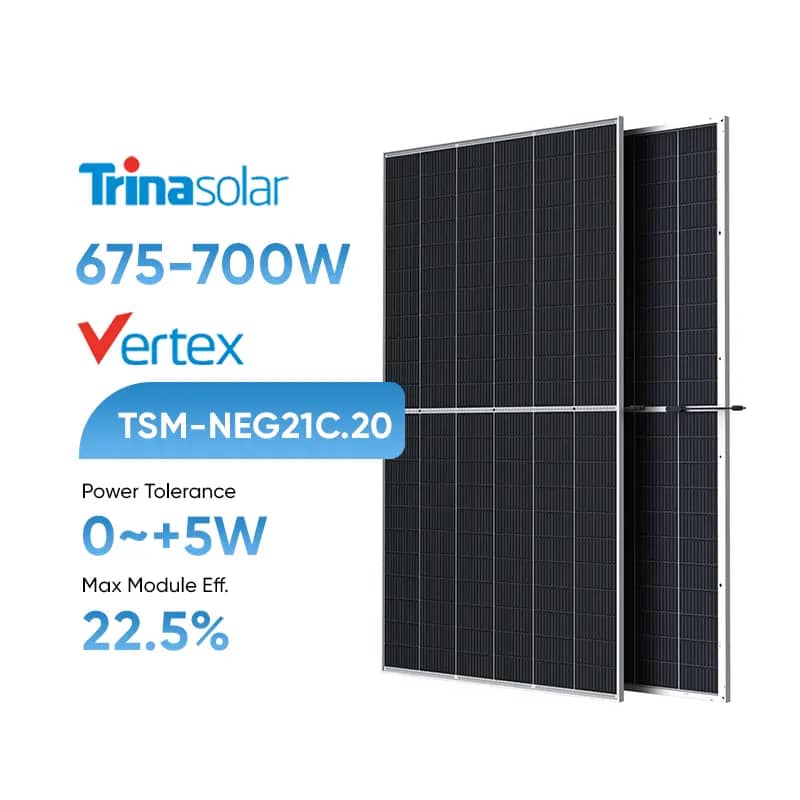


Trina Solar 650-670W Vertex TSM-DE21 Panel Photovoltaic Modules
- Category: Trina Solar Panels
- Features
Product Description
Trina Solar Vertex TSM-DE21 is a high-power monocrystalline PERC solar panel designed for utility-scale photovoltaic projects, commercial solar installations, and large-scale renewable energy systems. Featuring advanced 210mm silicon wafer technology, high-density interconnect technology, and multi-busbar (MBB) design, the Vertex DE21 series delivers outstanding power output from 650W to 670W with a maximum module efficiency of 21.6%.
The Trina Solar 670W Vertex module is engineered to reduce the total cost of solar energy generation by increasing power output per module, lowering Balance of System (BOS) costs, reducing installation requirements, and improving overall project return on investment.
With optimized low-voltage design and higher module string power output, TSM-DE21 enables more modules to be connected within a single string, improving system efficiency and reducing photovoltaic system construction costs.
Designed for demanding outdoor environments, the Vertex DE21 solar panel provides excellent reliability against PID, salt mist, ammonia, sand, high temperature, and high humidity conditions. It is an ideal solution for utility-scale solar farms, industrial PV systems, and commercial solar power projects.
Product Features
1. Ultra High Power Output up to 670W
Trina Solar Vertex TSM-DE21 delivers exceptional power generation performance with output ranging from 650W to 670W.
Key advantages:
- Maximum power output: 670W
- Maximum module efficiency: 21.6%
- Positive power tolerance: 0~+5W
- 132-cell monocrystalline PERC structure
- 210mm large-size silicon wafer technology
The higher module power allows solar developers to:
- Reduce the number of modules required
- Lower installation costs
- Reduce land usage
- Improve photovoltaic system economics
2. Advanced 210mm Silicon Wafer & High Density Interconnect Technology
The Vertex DE21 series adopts large-format 210mm silicon wafer technology combined with high-density interconnection design.
Benefits include:
- Higher active cell area utilization
- Improved current collection capability
- Reduced internal electrical losses
- Higher module conversion efficiency
The optimized cell layout enables better energy generation performance while maintaining compatibility with mainstream solar mounting systems and inverters.
3. Multi-Busbar Technology for Improved Performance
The Trina Vertex TSM-DE21 uses advanced multi-busbar (MBB) technology to improve photovoltaic performance.
Advantages:
- Better light trapping capability
- Lower series resistance
- Improved current collection
- Enhanced module reliability
This technology helps maintain stable energy production under different environmental conditions.
4. High Energy Yield Under Real Conditions
The Vertex DE21 module is optimized for real-world operating environments.
Performance advantages:
- Excellent low irradiation performance
- Improved Incident Angle Modifier (IAM)
- Better energy output under partial shading conditions
- Lower operating temperature
Temperature coefficient:
- Pmax: -0.34%/℃
The optimized thermal performance helps maintain higher output during hot climate operation.
5. Superior Reliability and Harsh Environment Resistance
Built for long-term outdoor operation, the TSM-DE21 photovoltaic module provides excellent durability.
Certified resistance against:
- Salt mist environments
- Ammonia corrosion
- Sand and dust exposure
- High temperature
- High humidity
Mechanical load capability:
- Positive load: 5400 Pa
- Negative load: 2400 Pa
Suitable applications:
- Desert solar farms
- Coastal photovoltaic projects
- Industrial solar systems
- Utility-scale installations
6. Long-Term Performance Warranty
Trina Solar provides reliable long-term performance assurance:
- 12-year product warranty
- 25-year power warranty
- First-year degradation: 2%
- Annual degradation: 0.55%
- Guaranteed output after 25 years: 84.8%
This ensures stable power generation throughout the photovoltaic system lifecycle.
Technical Specifications
Electrical Characteristics (STC)
| Parameter | 650W | 655W | 660W | 665W | 670W |
|---|---|---|---|---|---|
| Maximum Power (Pmax) | 650W | 655W | 660W | 665W | 670W |
| Module Efficiency | 20.9% | 21.1% | 21.2% | 21.4% | 21.6% |
| Maximum Power Voltage (Vmp) | 37.4V | 37.6V | 37.8V | 38.0V | 38.2V |
| Maximum Power Current (Imp) | 17.39A | 17.43A | 17.47A | 17.51A | 17.55A |
| Open Circuit Voltage (Voc) | 45.3V | 45.5V | 45.7V | 45.9V | 46.1V |
| Short Circuit Current (Isc) | 18.44A | 18.48A | 18.53A | 18.57A | 18.62A |
Mechanical Specifications
| Parameter | Specification |
|---|---|
| Solar Cell Type | Monocrystalline PERC |
| Module Type | Monofacial Backsheet Module |
| Cell Number | 132 Cells |
| Wafer Size | 210mm |
| Dimensions | 2384 × 1303 × 35 mm |
| Weight | Approx. 33.6 kg |
| Front Glass | 3.2mm High Transmission AR Coated Heat Strengthened Glass |
| Frame | Anodized Aluminum Alloy |
| Junction Box | IP68 Rated |
| Connector | MC4 EVO2 / TS4 |
| Cable | 4.0 mm² |
Operating Conditions
| Parameter | Specification |
|---|---|
| Operating Temperature | -40℃ ~ +85℃ |
| Maximum System Voltage | 1500V DC |
| Maximum Series Fuse Rating | 30A |
| NOCT | 43 ± 2℃ |
| Temperature Coefficient (Pmax) | -0.34%/℃ |
| Temperature Coefficient (Voc) | -0.25%/℃ |
| Temperature Coefficient (Isc) | +0.04%/℃ |