

Solar Panel Performance Calculation: How to Determine System Capacity Accurately
When designing a solar panel system, accurately calculating system performance is one of the most important steps. It determines the amount of electricity the system can generate and ensures efficient operation. An undersized solar system may fail to meet the energy needs of a home or commercial facility, while an oversized system can result in unnecessary investment costs.
To determine the appropriate solar system capacity, several factors must be considered, including solar panel performance, panel dimensions, available sunlight hours at the installation location, and other variables that influence energy production.
This article explains how to accurately calculate solar panel performance, introduces methods for estimating the energy output of individual panels and complete solar systems, and discusses key factors that should be considered during system design and installation planning.
Why Is Accurate Solar Panel Performance Calculation Important?
Accurate solar panel performance calculations are essential for proper system sizing because they determine whether a solar system can meet the required energy consumption needs.
For example, if a household uses 4,000 kWh of electricity per year, the solar system should have sufficient capacity to generate a similar amount of energy annually. In Hungary, the annual sunshine duration varies between approximately 1,100 and 1,300 hours depending on the region. Under these conditions, a 1-kilowatt peak (kWp) solar system can produce around 1,100–1,300 kWh of electricity per year.
Using Tongwei Solar 440 Wp panels as an example, each panel has a capacity of approximately 0.44 kWp. To achieve an annual energy output of 4,000 kWh, a solar system with a capacity of around 3.5–4 kWp is required, which corresponds to approximately 8–9 panels.
Measuring Solar Panel Performance: Per Panel Output or Per Square Meter
Solar panel performance can be measured based on the output of an individual panel or the power generation capacity per square meter, depending on the purpose of the evaluation.
For example, the Tongwei Solar 440 Wp N-type panel has a rated power output of 440 Wp, meaning it can deliver up to this power level under standard test conditions. With a panel surface area of approximately 2 m², its power output per square meter is about 220 W/m².
This calculation is useful for evaluating roof space utilization and determining the maximum solar system capacity that can be installed within a specific area.
How to Calculate Daily and Annual Solar Energy Production
The energy output of a solar system mainly depends on the installed system capacity and the available sunlight hours at the installation location. In Hungary, annual sunshine duration typically ranges from 1,100 to 1,300 hours depending on the region. For a system equipped with Tongwei Solar 440 Wp N-type panels, each panel provides a nominal capacity of 0.44 kWp.
If a household installs 10 panels, the total installed capacity will be 4.4 kWp. The annual energy production can be estimated by multiplying the system capacity by the annual sunshine hours. For a location with 1,200 sunshine hours per year, a 4.4 kWp solar system can generate approximately **5,280 kWh annually** (4.4 × 1,200 = 5,280 kWh).
Daily energy production can be calculated by multiplying the system capacity by the number of effective sunlight hours on a specific day. For example, with 5 hours of full sunlight on a clear summer day, a 4.4 kWp system can generate approximately **22 kWh** of electricity (4.4 × 5 = 22 kWh).
Because sunlight availability changes throughout the year, daily solar production will vary by season, with lower output during winter and higher generation during summer.
What Factors Influence Solar Panel Performance?
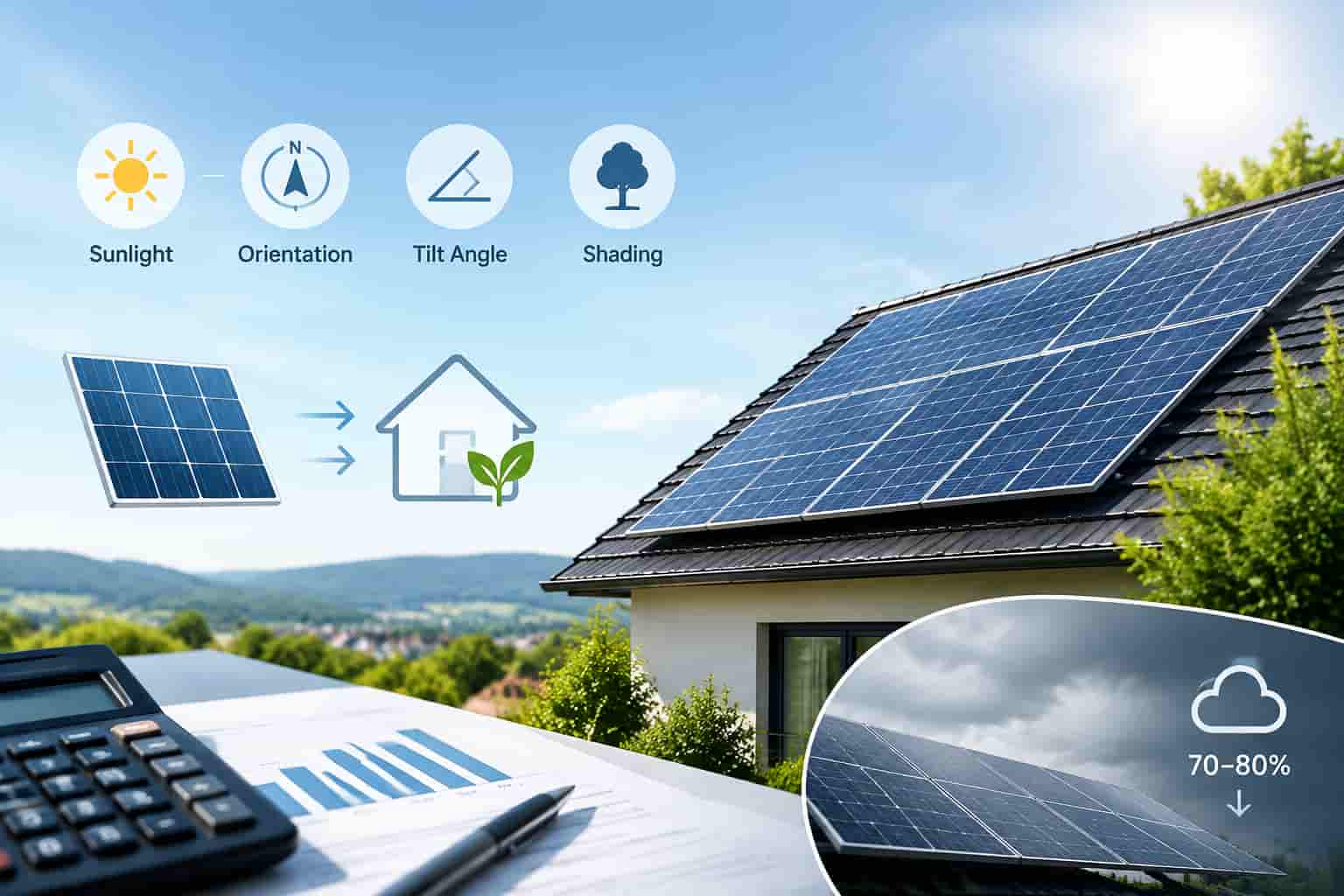
Solar panel performance is affected by a variety of external and internal factors that determine the amount of electricity a system can generate. One of the most important factors is solar radiation intensity, which changes depending on geographical location and seasonal conditions. In Hungary, for example, solar radiation is stronger and daylight hours are longer during the summer, while winter brings shorter days and a lower sun angle, resulting in reduced solar energy availability.
The orientation and tilt angle of solar panels also play an important role in system efficiency. For optimal energy generation in Hungary, solar panels are typically installed facing south with a tilt angle of approximately 30–35 degrees to maximize sunlight exposure throughout the year. Deviations from the ideal installation angle or direction can reduce overall system performance by around 10–20%.
Shading is another key factor that can significantly impact solar panel output. Even partial shading on a single panel caused by trees, buildings, or other obstacles may reduce the efficiency of the entire solar system. This is because conventional solar systems often connect panels in series, meaning that a shaded panel can limit the output of the entire panel string. To minimize these losses, solar optimizers can be used to enable individual panel-level optimization, allowing shaded panels to operate independently without reducing the performance of the remaining system.
FAQ:
1. How Do I Calculate the Number of Solar Panels I Need?
The required number of solar panels depends on your annual electricity consumption and the energy output of each panel.
For example, if a household consumes 4,000 kWh of electricity per year and uses Tongwei Solar 440 Wp panels, each panel can generate approximately 528 kWh annually under average conditions in Hungary.
To meet an annual electricity demand of 4,000 kWh, the system would require approximately 8 panels (4,000 ÷ 528 ≈ 7.57, rounded up to 8 panels).
2. What Factors Have the Greatest Impact on Solar Panel Performance?
Solar panel performance is mainly affected by sunshine duration, panel orientation, tilt angle, and shading conditions.
A south-facing installation with a tilt angle of 30–35 degrees can maximize energy production under typical conditions. Meanwhile, shading can significantly reduce system efficiency, which can be reduced by using solar optimizers to improve individual panel performance.
3. How Much Does Solar Panel Output Decrease on Cloudy Days?
Solar panels can still generate electricity under cloudy conditions, but their output may decrease by approximately 70–80% compared with sunny weather.
Although diffused sunlight allows solar panels to continue operating, the available solar energy is significantly lower. Therefore, weather variations should be considered when calculating system capacity and expected energy production.
4. Is It Necessary to Oversize a Solar System?
Oversizing a solar system is only beneficial when the additional energy can be effectively used, such as through battery storage or grid feed-in solutions.
If excess electricity cannot be consumed or stored, an oversized system may increase unnecessary investment costs. Therefore, accurate solar performance calculations are essential for selecting the appropriate system capacity.
5. What Maintenance Does a Solar System Require?
Solar systems generally require minimal maintenance, but regular inspections of panel cleanliness and electrical connections are recommended.
Dust, leaves, and bird droppings can reduce solar panel efficiency, so cleaning the panels at least once a year can help maintain optimal performance. Solar optimizers and monitoring systems can also provide continuous performance tracking and help identify potential issues quickly.